Onit Positioning on EMEA Government E-Invoicing Regulations and Continuous Transaction Controls (CTCs)
Executive Summary
Recent and upcoming government mandates in EMEA—such as Italy’s Sistema di Interscambio (SdI) and Belgium’s Peppol BIS 3.0 requirement—introduce strict e-invoicing and Continuous Transaction Control (CTC) obligations. These regulations aim to close VAT gaps and enforce real-time tax compliance. While these mandates impact how invoices are transmitted to tax authorities, they do not eliminate, or replace, the need for legal e-Billing systems like Onit. Onit remains critical for legal spend validation, compliance with Outside Counsel Guidelines (OCGs), and internal approval workflows.
Onit’s role is pre-approval and cost governance, not tax clearance. The responsibility for CTC compliance resides with law firms (supplier-side) or the client’s corporate finance/AP systems (buyer-side), supported by specialized tax engines. Onit facilitates this process by:
Enforcing billing guidelines and validating legal spend.
Providing Pro Forma Invoicing capabilities for adjustments and review before finalization.
Seamlessly integrating approved invoice data with corporate AP systems for payment processing.
Regulatory Context
CTC Mandates: Require real-time or pre-clearance submission of structured invoice data (XML, UBL, Peppol BIS 3.0) to government portals.
Impact on Legal eBilling: Legal eBilling systems (including Onit) are not designed as tax clearance engines. They validate cost and OCG compliance, but not tax compliance.
Onit’s Position
Onit is unaffected by CTC mandates because:
Law firms can submit invoices to government portals for clearance before or after sending them to clients via Onit.
The required government formats do not contain all the information fields that legal departments require on their invoices (i.e., UTBMS codes).
Standard LEDES formats do not contain all the information fields that government tax regulations require.
If we create a new format that is compatible with both legal e-billing and government e-invoicing requirements, it would not be a standard format, and adoption would be difficult.
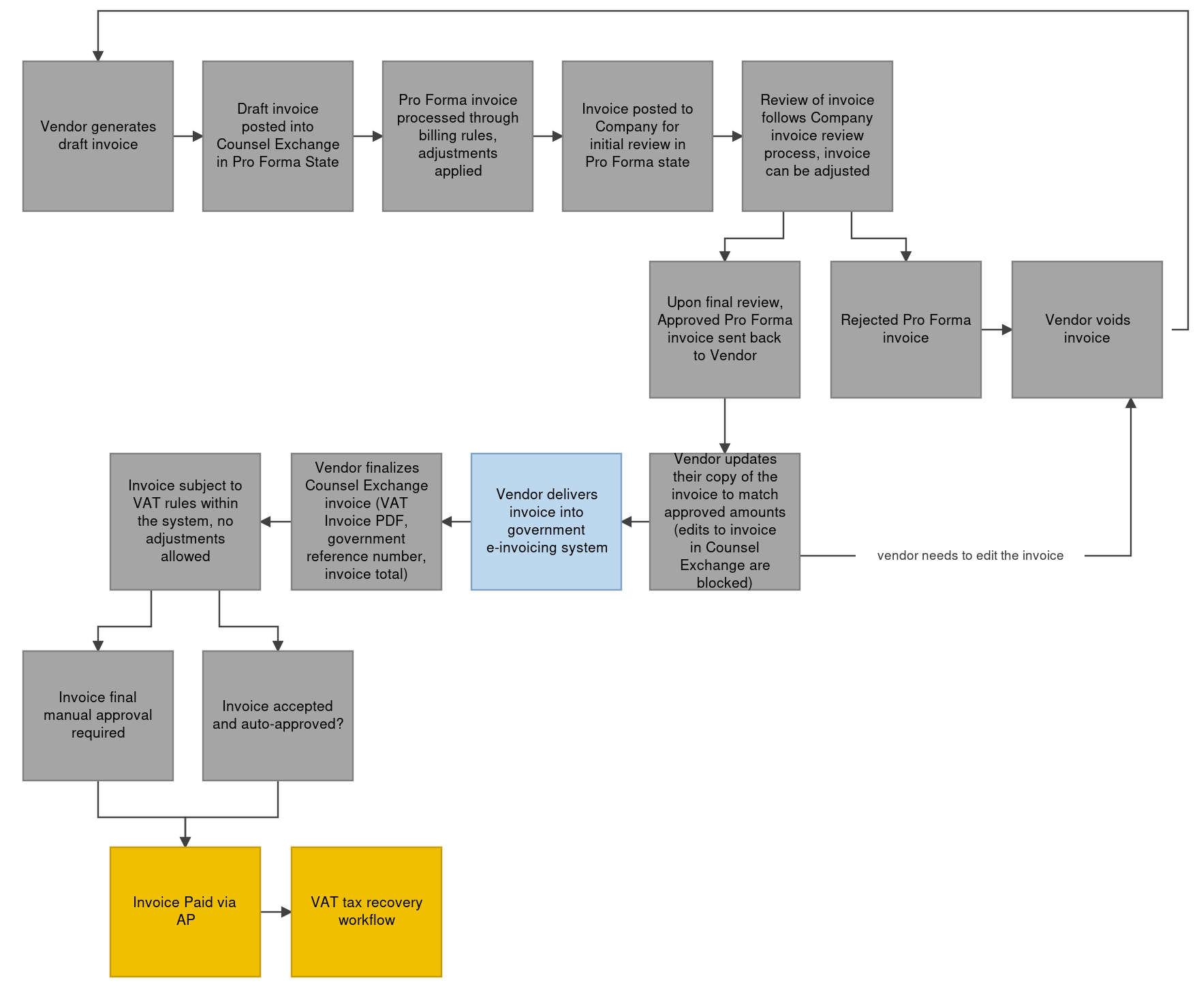
Onit supports Pro Forma Invoicing, enabling vendors to agree with clients on adjustments to line items and tax details before finalization.
Onit does not replace tax compliance systems; instead, it integrates with corporate AP/ERP systems that handle payment processing, XML/UBL conversion, government submission and clearance, and receipt of compliance acknowledgments.
Roles and Responsibilities
Party | Responsibilities |
Law Firms (Vendors) | Ensure compliance with local e-invoicing mandates; submit invoices to government portals (as required); provide clearance confirmation; upload LEDES or approved invoice data to Onit. |
Client Organization | Use Onit for legal spend validation and internal approval workflows; ensures integration with AP/ERP systems. |
Onit | Acts as pre-approval gate; provides Pro Forma Invoicing; enables API integration with AP/ERP systems. |
Corporate Finance / Tax Team | Owns tax validity and compliance; maintains specialized tax engines for XML/UBL conversion and government submission (as required). |
Recommended Workflow
Onit’s Pro Forma Invoicing feature gives vendors an easy way to add tax considerations and calculations to their invoices by allowing the client to make any necessary adjustments and edits during the submission process before vendor-side finalization. Pro Forma invoice is a draft invoice being presented to a client as an “estimated or preliminary invoice” and is common in countries where invoices include VAT taxes.
The VAT invoice is a Tax Document that is used to calculate VAT returns. The VAT liability attaches on the date of the issuance of the “Invoice.” Pro Forma invoicing functions to allow the vendor and the client to agree on the amount of the actual Invoice that is going to be later issued (the “Tax Document”) without the VAT liability attaching to either party; the vendor then completes the government e-invoice submission requirements before submitting the finalized invoice back to the client. On finalization, the vendor must provide the government e-invoice reference number, a finalized PDF copy of the invoice, and confirm the invoice total.
Outside of the Pro Forma feature, vendors can also provide the government invoice number via a field available during manual invoice creation or when editing a LEDES uploaded invoice. This field can be used to provide the client with the government e-invoice reference number.
In Conclusion
Onit remains a critical component of your legal operations, even under new e-invoicing mandates. These regulations do not replace the need for legal spend validation and internal compliance. Instead, they introduce an additional tax compliance layer, which is best managed by your corporate finance systems and specialized tax engines—not by legal e-Billing platforms.